On a wall in our office there is a light that can be switched two ways: from a panel that drives it through a Matter binding, and from an iPhone in the Apple Home app.
Both work. Only one of them feels like a light switch.
The binding path answers in about a hundred milliseconds. The Apple Home path sometimes spins, then shows the accessory as temporarily unavailable — and occasionally the light changes state a few minutes later, long after the interface gave up.
Two control paths, one light
This is the comparison worth keeping in mind, because it is what makes the problem diagnosable:
- Through binding, the panel sends the command itself, over the local Thread mesh, in an existing CASE session. No hub in the path.
- Through Apple Home, the iPhone hands the request to the home hub, the hub queues it, and the hub sends the command.
Same destination. Very different route.
Where three minutes and forty-seven seconds went
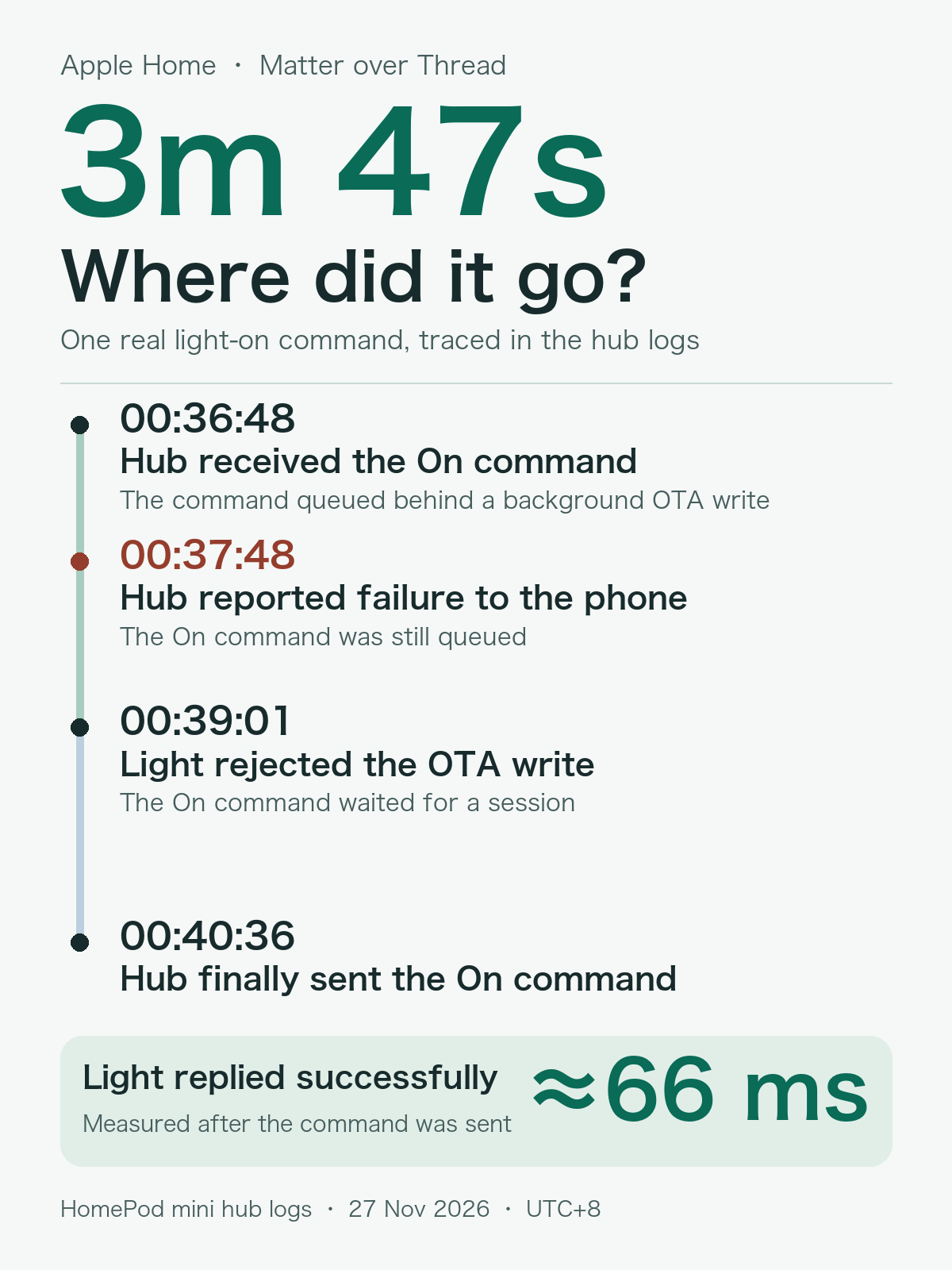
We captured the phone log, the hub's own archive and the light's return traffic, then lined them up on the same request.
The result was not what we expected:
- The phone sent the request and declared a timeout after roughly 21–22 seconds.
- The hub returned a write failure to the phone after about 60 seconds.
- The light eventually received the On/Off command and returned success in 66 milliseconds.
So the light was fast. The radio was fast. The command spent almost all of its life waiting inside the hub.
What it was waiting for
The hub was not idle. Right after taking over as the primary hub, it had started writing OTA provider configuration to the devices in the home — the attribute that tells a Matter accessory where to look for firmware updates.
On a device that does not support that cluster, the write returns immediately with UnsupportedCluster. You would expect that to be harmless. It is — for that one write.
What matters is what happens around it: the user's On/Off command had already been queued for the same device, and it waited behind that work for roughly another 94 seconds. The write itself took milliseconds. The queue cost minutes.
Two behaviours worth knowing
First: the bottleneck was not wireless. When we measured the radio, the recovery window showed a few thousand sends with zero channel-access failures and zero missing acknowledgements.
Second: the interface is not a reliable indicator of what the light did. The phone showed a failure while the command was still queued, and the light acted on it later. If you press the button again during an unknown state, you will mis-attribute the result.
What changed it
Turning off automatic updates for home accessories changed the picture. After that, the first two operations still took seconds, then both lights settled into 78–109 ms — the same order of magnitude as the binding path.
That is a useful data point, but we want to be careful about the conclusion: we have not yet reproduced "hub takeover after automatic updates are off" to see whether the takeover alone can still trigger the same writes. So treat this as an observed correlation with a plausible mechanism, not a proven fix.
What we take from this
For a product, the lesson is not "one path is bad". It is that the two paths serve different jobs.
A binding is the path that must work when something else is missing — which is exactly why we put the argument for it in a separate article. Apple Home is the path that gives you grouping, scenes, remote access and automation across vendors. You want both, and you want to know which one you are debugging.
For anyone chasing the same symptom, our next article is about collecting evidence that can actually be lined up in time: the phone diagnostic, the hub archive, and the device logs.
Written by ReZ-TI. We build Matter over Thread lighting and controls, and we write down what we find when they are deployed.